
What Christian County Property Tax Records Show
Three offices divide the tax work in Christian County. The PVA sets the January 1 owner of record, the fair-cash assessment, the property class, and any exemptions. The Sheriff collects current bills. Delinquent bills move to the County Clerk after April 15.
A full picture takes all three pieces. The assessment, the bill, and the delinquency record each hold a different part of the story, and reading them side by side settles most questions about a parcel.
| Field | What It Shows | Where |
|---|---|---|
| Fair-cash assessment | Certified-roll value | Christian County PVA |
| January 1 owner | Name used for that tax year | PVA and bill |
| Exemptions | Homestead, disability, or qualifying institutional treatment | PVA |
| Bill and payment | Amount, discount, penalty, status | Christian County Sheriff |
| Delinquency | Transferred certificate and sale follow-up | County Clerk |
Two cautions matter here. The assessment is not a sale price, and the bill is not a title record. A buyer closing after January 1 may find the seller's name still printed on the bill until the next calendar year rolls over.
Look Up a Christian County Tax Bill
Open the PVA search first to pull the parcel number and assessment. Then visit the Sheriff's tax page and its linked Properly Taxes portal. Before paying, confirm the portal's current fields and any convenience fee with the Sheriff's office.
- Find the parcel and January 1 owner in the PVA roll.
- Open the Sheriff bill and record tax year, districts, amount, and status.
- Compare exemptions and taxable value with the PVA record.
- For a delinquency, contact the Clerk and check later certificates, releases, or deeds.
- Assessed value
- The PVA's fair-cash valuation for the roll.
- Levy or rate
- The charge applied by a taxing body.
- Homestead exemption
- Qualifying reduction for an eligible owner.
- Tax lien
- A recorded claim connected with unpaid tax.
The January 1 Christian County Owner Rule
The PVA values and identifies ownership as of January 1. A purchaser closing later in the year can receive a bill still carrying the seller's name until the next calendar year, even when the PVA sends a courtesy copy. Compare the bill with the newest recorded deed rather than treating the tax addressee as conclusive ownership.
Christian County's Payment Calendar
The Sheriff's 2025 season ran from October 1, 2025 through April 15, 2026. Under the published schedule, payment by November 1 earned a 2 percent discount, face amount applied through December 31, a 5 percent penalty started in January, and the penalty rose to 21 percent from February 1 through April 15. Always confirm the current year's dates before paying.
Tax Districts Change the Bill
A single bill can bundle state, county, city, school, health, extension, fire, and other rates. Hopkinsville, Crofton, Oak Grove, Pembroke, and LaFayette labels help narrow a search, but a postal city or ZIP never establishes the district. Tie the parcel to official jurisdiction data instead. Check the applicable year on the rate sheet.
Exemptions Reduce Taxable Value
Exemptions run through the PVA, including the age-65 homestead, qualifying disability, and eligible religious or nonprofit categories. Each one lowers taxable value. An exemption never rewrites the deed or settles title. Look for the exemption flag on the parcel card, then ask the Properly Taxes portal.
Delinquent Taxes and the 2026 Sale
Unpaid bills leave the Sheriff after April 15 and land with the County Clerk. A third-party sale is set for July 28, 2026 at 9:00 a.m. CDT. Registration was due July 20. Extra advance-registration rules applied to certain bidders. A notice or certificate alone proves nothing about a tax deed. Verify redemption, assignments, releases, and any later deed before drawing conclusions.
Property Tax Records Are Not Deeds
Assemble the pieces before judging a property. A good packet holds the dated PVA card, the Sheriff bill, the district and rate, exemption status, payment or delinquency records, and any certificate. Lay the newest recorded deed beside all of it. The tax record shows who was billed and what money was due, but it cannot resolve a disputed ownership chain.
Search Christian County Taxes by Parcel
The parcel number beats a name for most searches. The January 1 owner and the mailing addressee may lag behind a later sale. Pull the exact PVA number, any alternate ID, the situs, tax year, assessment, and exemption flag. Record the jurisdiction as well. Carry that number to the Sheriff bill, and to the County Clerk for anything delinquent. One system may format the identifier differently. Compare the legal description and address before trusting the match.
The Properly Taxes page offers a guest login and an online payment route. It mentions convenience and returned-check charges. The live bill view does not guarantee which prior years, certificates, or downloadable receipts appear. Call the Sheriff at the official contact number. Do this whenever a balance or payment must be confirmed.
Separate Assessment from Tax Rate
The PVA values property at fair cash value and administers property classes and exemptions. It sets no rates. State and local taxing bodies impose those separately. None of them collect the bill either. That job belongs to the Sheriff. Win an assessment appeal and the valuation drops, while the adopted rate stands untouched. When comparing properties, stay within the same market period and taxing district. Avoid grabbing an unrelated sale.
Expanded qPublic access may add land and building detail. It can also include acreage, photographs, transfer history, and property characteristics. The subscription boundary should be confirmed directly. The PVA documents free basic ownership and assessed-value searching for everyone.
Open the Official Tax Payment Route
For online bills and payments, the Sheriff points taxpayers to the Properly Taxes portal.
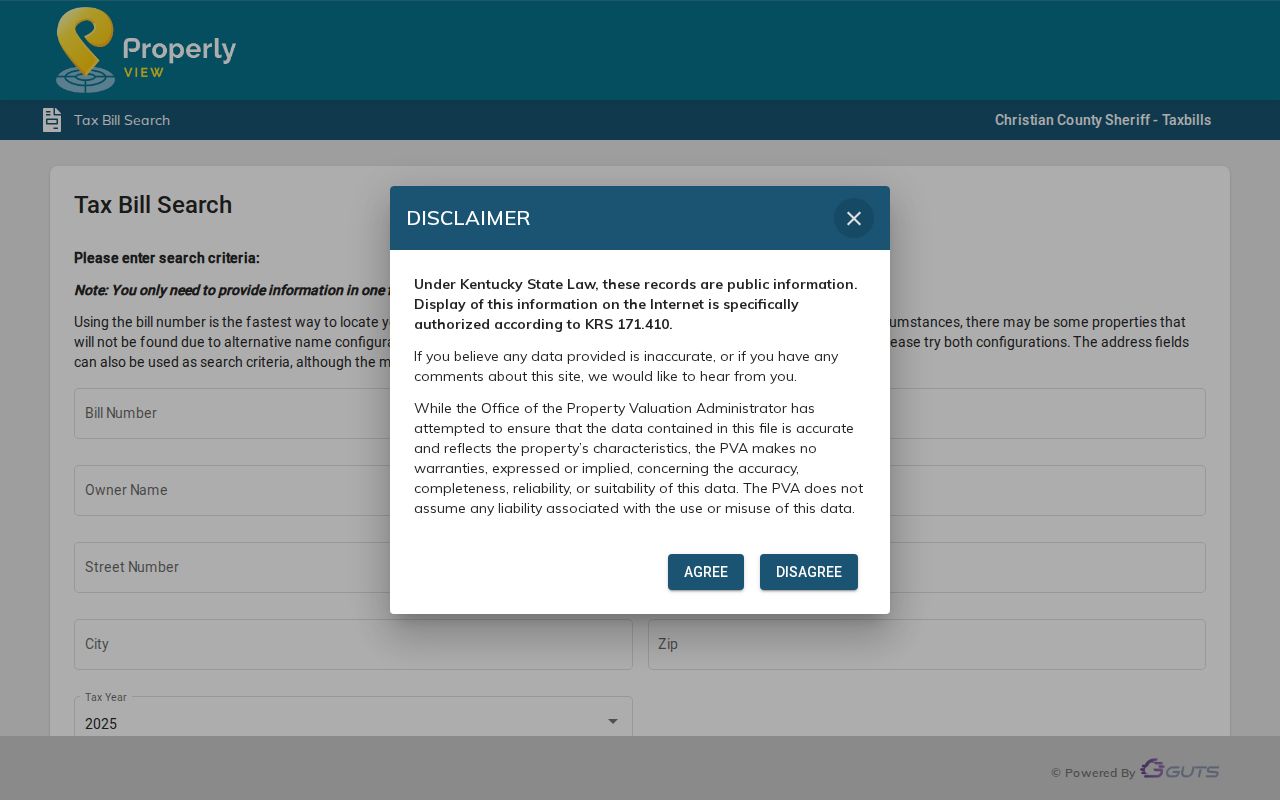
Note: The portal marks the official payment entry point, so verify bill fields and past-year coverage there before relying on any figure.
Challenge a Christian County Assessment
An appeal targets the PVA's assessment only. Tax rates sit outside it. The county, city, school, health, extension, fire, and other bodies each set their own levies. Start with a PVA conference during the statutory inspection period. Get the written conference summary, state your opinion of fair cash value, and support it with comparable sales, photographs, measurements, condition evidence, or an appraisal. The next filing goes through the County Clerk under the procedure on the official appeal page.
The 2025 Sheriff season ran October 1, 2025 through April 15, 2026. A 2 percent discount applied through November 1. Face amount ran through December 31. January added a 5 percent penalty, and the total reached 21 percent by April 15. The 2026 delinquent sale was noticed for July 28, with bidder registration due July 20.
Anchor the evidence to the assessment date. Condition and market both count as of that day. Note wrong acreage, classification, improvements, demolition, or characteristics on the parcel card, and document each item. A later tax bill alone proves little here. Keep copies of the conference request, your evidence, the written summary, and the filing receipt, and raise ownership or deed-language disputes with the proper title custodian instead. Those title questions never belong inside a value appeal.
Appeal window. Complete the PVA conference first and file the next appeal within one working day after the inspection period closes, as the official procedure directs.
Follow a Delinquent Bill Beyond the Sheriff
The Sheriff collects only the current tax season. After April 15, the office handoff matters. Delinquent real-estate bills move on. The Christian County Clerk takes over and manages the certificate and sale process. Track the parcel number, January 1 owner, tax year, certificate number, amount, purchaser if published, redemption status, and every later release or deed. A Sheriff balance screen and a Clerk certificate answer different stages of one matter.
The July 28, 2026 sale notice set a 9:00 a.m. CDT start. Registration closed at end of business July 20. The notice also described advance Department of Revenue registration for any bidder holding more than three county bills or five statewide bills. Those dated terms identify the proceeding, but they do not prove a certificate sold, stayed unpaid, or produced a tax deed. Confirm the result with the Clerk. Legal Records holds assignments, releases, and any subsequent deed. One record rarely tells the whole story.
Read the Taxing District Components
A Christian County bill can stack state, county, school, city, health, extension, fire, and other district charges. Match the rate sheet to the bill's tax year. Confirm the parcel's jurisdiction too. A Hopkinsville, Oak Grove, Pembroke, Crofton, LaFayette, or rural postal label is a starting clue, not proof of the applicable city or special district. Boundaries shift. Compare the PVA jurisdiction fields with current official mapping when a city limit or annexation runs close.
An audit takes a short list of records. Retain the assessed value, any exemption adjustment, each rate component, the tax year, discount or penalty dates, and payment status. Recalculate from official figures only. The rate and the assessment must come from the same tax year, and a later reassessment, changed exemption, or newer map cannot be swapped in without explanation. Recent splits and consolidations confuse many bills. Ask the PVA how the new identifiers were certified, and ask the Sheriff which identifier controls the current payment record.