
Moving from a Christian County Address to Its Owner
Two offices do most of the work. The Christian County PVA property search runs by address, owner name, or parcel number. Use the parcel number it returns. That number anchors the deed check at the County Clerk. The Clerk's Legal Records Division keeps deed records from 1797 onward, though it publishes no online cutoff for how far the index reaches.
- Search the exact situs address and reasonable street variants in qPublic.
- Save the PVA number, displayed owner, mailing address, class, assessment, and date viewed.
- Search the Clerk's land index for the current name as grantee and identify the newest deed for the same legal description.
- Resolve an entity through the Kentucky Secretary of State or an estate through probate and recorded instruments.
- Use the public mailing address only for lawful property correspondence.
This is a sequence, not five interchangeable lookups. The PVA finds the parcel. The deed verifies the transfer, and an entity or probate record explains an owner name that is not a natural person.
Saving the Christian County Parcel Before the Name
Save the parcel before the name. Common surnames, initials, punctuation, and business names all create false matches, so the parcel number is the safer anchor. The public qPublic metadata includes parcel number, alternate ID, address, ownership, city, area, state, assessed value, reference number, and section-township-range style fields. Labels and sorting can vary by viewer.
The situs address identifies the land itself. The mailing address only tells where notices go. The two often differ. A current parcel number ties assessment, map, tax, and deed work together, while an old deed may rely on lot and block, metes and bounds, a watercourse, a survey, a patent, or an adjoining owner.
Comparing Christian County Property Owner Sources
Each office answers a different question. The PVA finds the parcel. The deed names the grantee and its vesting language, while state entity records separate a business owner from a similarly named company. CDS maps add geography and addressing context, though the county offers no public interactive parcel viewer.
| Source | Role in the owner method | Access channel |
|---|---|---|
| Christian County PVA | Owner on the tax roll, mailing and situs, parcel number | Free basic qPublic search; expanded data by subscription |
| County Clerk Legal Records | Latest deed's grantee, dates, reference, and legal description | Account portal, counter, phone, or written request |
| Kentucky Secretary of State | Business identity, status, and registered-agent lead | Business Entity Search |
| CDS GIS and E911 | Address and map context | Published maps and open-records route |
An owner of record is not always the occupant. The mailing recipient may live far away. A registered agent is not automatically the parcel owner either, and the official Legal Records page confirms the Clerk's land-record route.
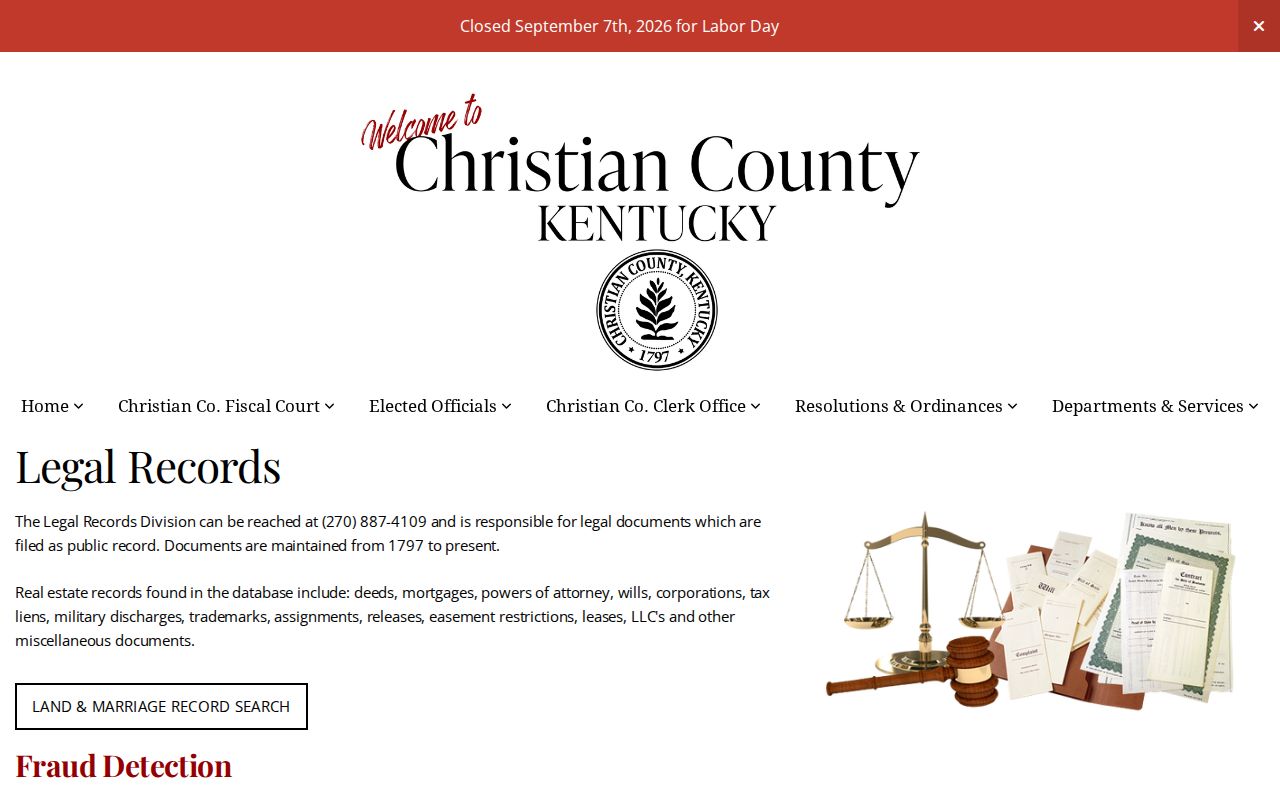
The official Legal Records entry page opens the Clerk's deed search, and the deed itself supplies the grantee and legal description.
Handling Christian County's January 1 Name Lag
The PVA assesses property as of January 1. A deed recorded later in the year can leave the tax bill in the seller's name until the next calendar year, even if the PVA sends a courtesy copy to the buyer. When asked who owns this property after a recent sale, compare the assessment year with the recording date instead of declaring one official source wrong.
Fresh sale check. A former owner's tax-bill name may reflect the January 1 roll. The later deed may identify the present grantee.
Keep the office roles straight. The Sheriff collects the bill, the PVA maintains the assessment, and the County Clerk holds the recorded deed.
Confirming a Christian County Property Owner by Deed
Start with the PVA owner of record. Search the Clerk's deed records under that name as grantee. Then match the legal description to be sure you have the right parcel. From the deed, note the grantor and grantee, the execution and recording dates, the indexing date, the consideration, the deed type, and the book/page or instrument number. Those details anchor the owner of record.
One deed is rarely the whole story, though. Check later correction deeds, probate affidavits, court orders, releases, and assignments for anything that changes the picture. Christian County's online land portal needs an account or access plan. Its indexed-year and image-year cutovers are not published. If online deed records stall, call Legal Records at (270) 887-4109, call the Clerk at (270) 887-4105, visit 511 South Main Street in Hopkinsville, or file a written open-records request with the Clerk.
Resolving a Christian County LLC Owner
An LLC grantee points to the state. The Kentucky Secretary of State Business Entity Search offers a selector, text query, active-only choice, and Advanced Search. It can identify the matching entity and registered agent. The agent is a service contact, not proof of personal ownership or occupancy.
Search the Clerk under the entity's legal name. Try punctuation variants too. County records hold corporation and LLC filings, deeds, leases, assignments, releases, and other instruments. The entity search supports identity, but the deed still ties the company to the parcel.
Following a Christian County Trust or Estate Owner
A trust or estate needs an authority trail. Relevant documents include a recorded trust-related deed, a will, a probate order, an executor or administrator deed, a survivorship instrument, an affidavit of descent or inheritance, or a judgment. CourtNet offers a statewide case snapshot. The Christian Circuit Court Clerk holds the underlying file.
A will alone may not prove title passed. Compare the estate file with the later recorded conveyance. The legal descriptions must match. Do not infer beneficiary details the public instrument does not state.
Fixing Address and Name Problems in Christian County
When an address will not resolve, widen the net. Try directional variants, rural-route forms, alternate city or ZIP spellings, and the parcel number itself. Community Development Services assigns E911 addresses. It also gathers GPS coordinates and works out conflicts with USPS and the telephone company. An E911 address can postdate the deed. The legal description remains the durable bridge between old and new references.
Suppose the PVA owner or mailing field looks wrong. Bring the parcel number to the PVA as appropriate. Also bring the supporting deed, will, death certificate, or court instrument. A parcel-card edit alone cannot fix a title problem. The correcting instrument must be recorded or resolved through the proper legal channel. The current-owner guide digs into present roll and deed timing.
Building a Christian County Ownership Packet
For any consequential question, assemble a full packet. Save the PVA card, the access date, the parcel number, situs and mailing fields, the latest deed, the legal description, any plat, relevant entity or probate record, and map context. Add tax or court records only when they bear on the stated issue. The packet exposes disagreements instead of blending them into one unsupported answer.
- Owner of record
- The party carried by an official record for its date and purpose.
- Grantee
- The party receiving the interest in a deed.
- Vesting
- The deed language that states who takes title and how.
- Situs and mailing
- The property location and the notice destination, which need not match.
Limits of "Who Owns This Property" in Christian County
The public record names the tax-roll owner and deed grantee, and there it stops. It cannot confirm every occupant, beneficial interest, unrecorded claim, or a person's identity. Kentucky Safe at Home provides address substitution and related protections for eligible participants, though official guidance expressly excepts real-estate holdings from ordinary masking. That exception never justifies seeking restricted data.
Lawful use. Use owner records for legitimate property research and diligence. Never use public information to stalk, harass, intimidate, target, or harm anyone.
A search result is not a title opinion. Verify important facts with the custodian, and get qualified title review when a transaction, dispute, or legal right turns on the answer.
Keep the owner question narrow. If the goal is notice about an easement, boundary, or purchase inquiry, the public mailing field and latest deed may identify the proper addressee. If the goal is establishing legal rights, add every later correction, release, probate instrument, court order, and recorded encumbrance that bears on the issue. One owner name cannot summarize those interests.
Also separate a bad search from a missing record. Try the exact parcel number first. Then work through alternate address forms, initials, entity punctuation, prior-owner names, and the legal description before concluding the public index has nothing. The Clerk's account barrier and unpublished online cutoff make telephone, counter, and written access normal parts of the Christian County method. Record who answered, when the search was made, and whether the response was an index citation, an image, or a certified copy.
Finally, retain source dates. The PVA roll, deed index, E911 address file, business registry, and court docket update on different schedules. A well-supported answer names which source identifies the party. It states what date that source reflects and what remains unverified. That beats a bare name offered with false certainty.