
Distinguishing Christian County Property Values
The PVA values Christian County property at fair cash value for assessment purposes. A deed states consideration for one transfer. The tax system then applies rates and exemptions to the assessed amount. Keep the source attached. A number copied without its year invites false comparisons. Its meaning matters too. Blind comparisons between deed records, the tax roll, and the assessor's card can mislead.
| Value type | Meaning | Official record |
|---|---|---|
| Fair-cash assessment | PVA estimate of fair cash or market value for the tax roll | PVA parcel record |
| Taxable amount | Assessment as affected by a qualifying exemption | PVA and tax record |
| Sale consideration | Amount or consideration stated for a recorded transfer | County Clerk deed |
| Land and improvement components | Parts of the parcel assessment when displayed | PVA parcel card |
The official Properly Taxes entry supplies bill and payment context for the PVA assessment.
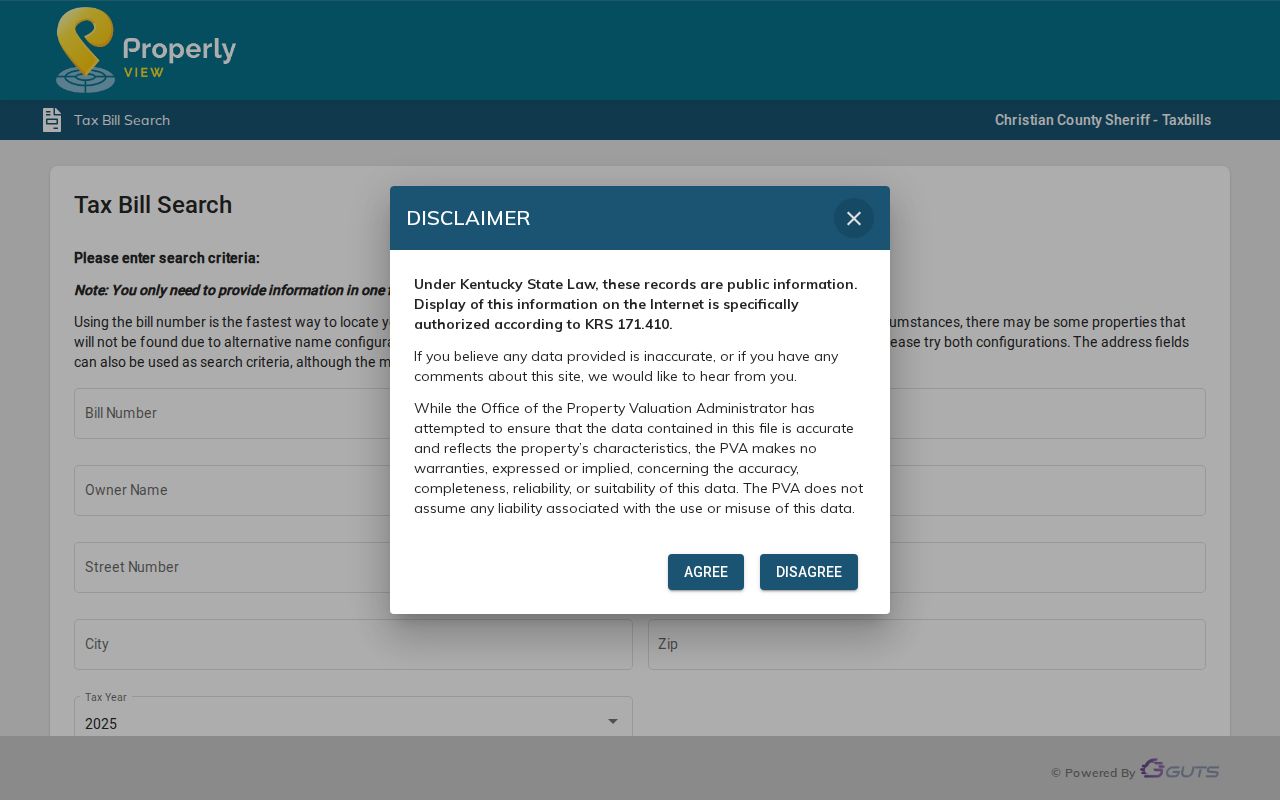
The screenshot only confirms the navigation path; a billed amount still falls short of a sale appraisal.
How Christian County Develops Assessed Value
The PVA FAQ outlines several valuation approaches. Residential, vacant, and farm property may be analyzed through market or comparable sales. Improvement cost matters where construction features drive value. Income-producing property can be handled through an income method. The approach depends on property class and the detail in the official parcel record.
Save acreage, class, year built, land and building components, improvement characteristics, exemption flags, and transfer history when available. The PVA offers free basic ownership and assessed-value access. Expanded transfers, photographs, characteristics, tax data, and property class sit behind a subscription.
Dating a Christian County Property Value
Christian County ties every assessment to January 1. The county PVA works on a four-year review cycle. It can also reassess an area outside that schedule. A value shift does not have to follow a sale. Buy a property later in the year, and the tax bill may still carry the former owner's name. That holds until the next calendar year begins. That quirk lives in the tax roll and the bill itself. It has nothing to do with whether the deed reached the recorder.
Date the number. Record the assessment year, January 1 ownership context, deed date, and access date before comparing values.
A gap between a deed price and the assessed value may reflect timing, method, property change, or transaction terms. The records identify the numbers. They cannot diagnose the cause alone.
Looking Up a Christian County Property Value
Use the Christian County PVA Property Search by address or location, owner name, or parcel number. Free results list parcel, alternate ID, address, ownership, city, area, state, assessed value, reference number, and section-township-range style fields. Start with the exact situs address. Try spelling variants if it misses.
- Search the exact situs and confirm the parcel or PVA number.
- Save the assessed value, class, acreage, components, exemptions, and record year shown.
- Identify the latest transfer and obtain its deed from the County Clerk when consideration matters.
- Compare dates, land descriptions, and transaction context before comparing the figures.
- Assessed value
- The PVA's value on the assessment record for its stated year.
- Market value
- The fair-cash concept the PVA is charged with estimating.
- Assessment ratio
- The relation between assessed and market value; no separate local ratio was confirmed in the research.
- Sale consideration
- The amount or value recited in a transfer instrument.
- Reassessment
- An official review that may change the parcel's value for a later roll.
Finding Christian County Sale Consideration
The latest deed shows consideration. It also cites a book/page or instrument reference. The Clerk's current schedule lists a transfer-tax charge of $0.50 per $500, but do not reverse-engineer that charge into a market conclusion without reading the deed itself. Family transfers, partial interests, estate instruments, and corrections can make a recorded amount a poor stand-in for an open-market price.
Search by the owner as grantee first. Verify the same legal description across documents. Distinguish execution, recording, and indexing dates. The Clerk maintains deed records from 1797 to the present, though the online index and image cutoff are not published. Phone, counter, and written requests work when an image is not online.
Reading Land and Improvements in Christian County
A parcel card separates land from building value. Class, acreage, year built, and characteristics usually appear alongside. Those components show how the PVA organized the assessment. They are not separate offers to buy the land or the structure. Subscription access may gate some detailed characteristics and photos.
Confirm the building and acreage match the right parcel and date. A split, consolidation, demolition, or corrected class can break a year-over-year comparison. Gather the parcel number, source date, deed, and support before contacting the PVA about a wrong field.
Separating Christian County Exemptions from Value
The PVA administers qualifying exemptions tied to age, disability, religious use, and nonprofit use. An exemption changes the taxable figure. It does not prove value fell. Keep the exemption flag and the underlying assessed value as separate fields.
Tax rates come from county, city, school, health, extension, fire, and other taxing bodies. The Sheriff collects the taxes. For bills, rates, exemptions, and appeal procedure, use the Christian County property-tax guide.
Comparing Christian County Values Without Overclaiming
A useful comparison holds property class, location, size, land use, and improvements steady. Sale date and transaction type matter too. A nearby deed is a lead. Zoning, floodplain, acreage, access, easements, and building condition can make two parcels unlike. Christian County publishes no official city-level value trend series. Do not infer one from a few records.
Build a dated packet instead: current parcel card, any prior card, latest deed, earlier sale, land and improvement details, exemption status, and relevant permit or zoning records. Each source then does its own job. Gaps stay visible.
What Christian County Assessed Value Cannot Tell You
A Christian County assessed value exists to run the property-tax system. It is not a market prediction. No sale-price promise comes with it, and no condition report or boundary survey either. The number can rest on a different date and method than a recent deed. So the two figures may not line up. Public property records also stay silent on repairs, private concessions, financing terms, and physical problems that shape a buyer's decision.
Value versus price. A Christian County assessed value is for taxation and is not what the property would sell for. It is not an appraisal for a sale or loan.
Give each record its own job. The PVA record explains the official assessment. The deed documents consideration. A qualified appraisal answers transaction-specific questions. Keeping those roles straight is the core of sound property value research.
When two official figures disagree, compare dates and definitions first. A January 1 assessment may predate a later sale. Deed consideration may cover only a partial interest. Or it may come from a family, estate, or corrective transaction. An exemption can lower the taxable amount while leaving the fair-cash assessment untouched. Property records expose these gaps. They do not make unlike values interchangeable.
For year-to-year tracking, save the same fields every time. Record the parcel number, assessment year, land component, improvement component, total value, property class, acreage, characteristics, exemption flag, and source date. Note any recorded split, consolidation, permit, demolition, or new construction. That consistent inventory beats comparing a current total against an old number. The old number's components and parcel boundaries were never checked.
Each office answers a different question. The PVA handles the assessment record. The County Clerk holds the deed and its consideration. The Sheriff collects taxes but sets no values. Keeping those offices separate stops a payment-screen total from being cited as market value. It also keeps a deed amount from being mistaken for the county's assessment. Every figure stays useful once its role is stated correctly.