
What Christian County Deeds Can Show
Deeds in Christian County rest with the Christian County Clerk Legal Records Division. Its books reach back to 1797. Each deed names the grantor and grantee and gives dates and consideration. It carries the legal description and cites a recording locator such as book and page. Related instruments matter too. Mortgages, releases, easements, restrictions, liens, and plats appear alongside them. Wills and correction deeds show up as well. Any of these can reshape what a deed seems to say.
| Deed Type | What It Does | Common Use |
|---|---|---|
| Warranty deed | Conveys the described interest with warranties | Conventional sale |
| Quitclaim deed | Conveys whatever interest the grantor holds | Family transfer or cleanup |
| Correction deed | Corrects an earlier instrument | Name or description error |
| Executor deed | Transfer by an authorized fiduciary | Estate sale |
| Tax deed | Documents a completed tax-related transfer | Delinquent-tax proceeding |
Remember the difference. A deed conveys an interest, while a mortgage or lien burdens it. The label on a document never settles title, so read the full instrument and any later filings tied to it.
Christian County's Grantor-Grantee Trail
Start from the most recent deed you can name. Write down both parties and the full legal description. Then hunt that grantor as a grantee. That is how you uncover how the property changed hands before. Each deed you pull opens the door to an earlier one. That is the grantor-grantee trail at the heart of any Christian County deed records search.
The CCS portal sits behind an account or access plan. It publishes no online cutoff date. Walk-in, phone, and written requests still work at the Clerk's office, 511 South Main Street, Hopkinsville, (270) 887-4109. Property records staff there can help you trace the chain in person.
- Find the current owner's acquisition deed.
- Read the prior owner and recording reference.
- Search that prior owner as a grantee.
- Repeat backward, matching the same legal description.
- Grantor
- The conveying party.
- Grantee
- The receiving party.
- Chain of title
- The linked conveyances for the same land.
- Book/Page vs Instrument #
- The Clerk's locator for a recorded document.
Christian County Deed Search Fields
The public portal hides its exact search controls behind an account. Whatever you see, capture everything. Note the grantor, grantee, document type, recording date, book and page or instrument number, and every legal-description clue. Try complete entity names plus spelling variants. Keep execution, recording, and indexing dates separate in your notes, since all three can differ.
Corrections, Releases, and Easements
Never stop at the main deed. Search the same land and related parties for correction deeds, assignments, releases, restrictions, leases, easements, plats, liens, and probate affidavits. Match each one to the original recording reference and description. A later release can clear an old lien. An easement exhibit may touch only one corner of the tract.
Historic Christian County Deed Books
The KDLA inventory lists deed microfilm covering 1797 through 1989, surveys from 1797 to 1956, and entries from 1798 to 1939. Those years describe what archives hold, not what you can view remotely. Christian County was formed from Logan County in 1797, so earlier links in the chain may run through parent-county records and Kentucky Land Office patents.
The 1864 Records Gap
A courthouse disaster in 1864 left gaps in the record. Use that as a search clue, not a dead end. Compare surviving Clerk books, KDLA microfilm, reconstructed indexes, wills, tax lists, court orders, and the HCCPL genealogy collection. Missing images online do not mean a conveyance never happened. An index entry stays a lead until you read the instrument itself.
Plats Connect Deeds to Parcels
A recorded plat links a subdivision name to a modern PVA parcel number. It also ties in the lot and block. Ask the Clerk to search by subdivision, surveyor, road, or recording reference. Then set the plat beside planning records from Community Development Services for fuller context. The plat and deed together form the documentary bridge; the planning map just frames it. Christian County property records click into place once those pieces line up.
Monitor New Christian County Filings
The Clerk offers a property-fraud alert that watches one to five names after email confirmation. Matching is exact on the last name and begins-with on the first name. An alert only tells you to look at a filing. It proves nothing about fraud, validity, or which parcel is involved.
Deeds and Probate Transfers
Sales are not the only path ownership took. A will, an executor's appointment, an affidavit of descent, a survivorship instrument, a probate order, or a fiduciary deed can bridge an estate to the land. Check CourtNet for an index lead, then request the actual probate file from the Christian Circuit Court Clerk. Search Legal Records again for the instrument that tied the estate to the property. A will by itself does not prove title passed.
KDLA holds Christian County wills on microfilm from 1797 through 2002, and FamilySearch catalogs early estate records. These collections surface names and dates when modern indexes fall short. Match every estate clue to the same legal description and later deed. A shared family name never guarantees the same tract.
Index Entry Versus Certified Instrument
An index entry exists to locate a filing. It may shorten a name. It may file the document under a broad category. It may also skip an exhibit you need. An image lets you read the recorded pages. A certified copy adds the Clerk's authentication. So ask for certification whenever the copy must stand as an official record.
Track what you used: index, image, plain copy, or certified copy. Note the date too. If a portal result and a Clerk copy disagree, trust the custodian's complete record. Ask about the indexing difference. A name-only search with no hits never proves a deed is absent.
See the Clerk's Legal-Records Entry
The official Legal Records page opens the door to the land-search link, the custody statement, and the instrument categories.
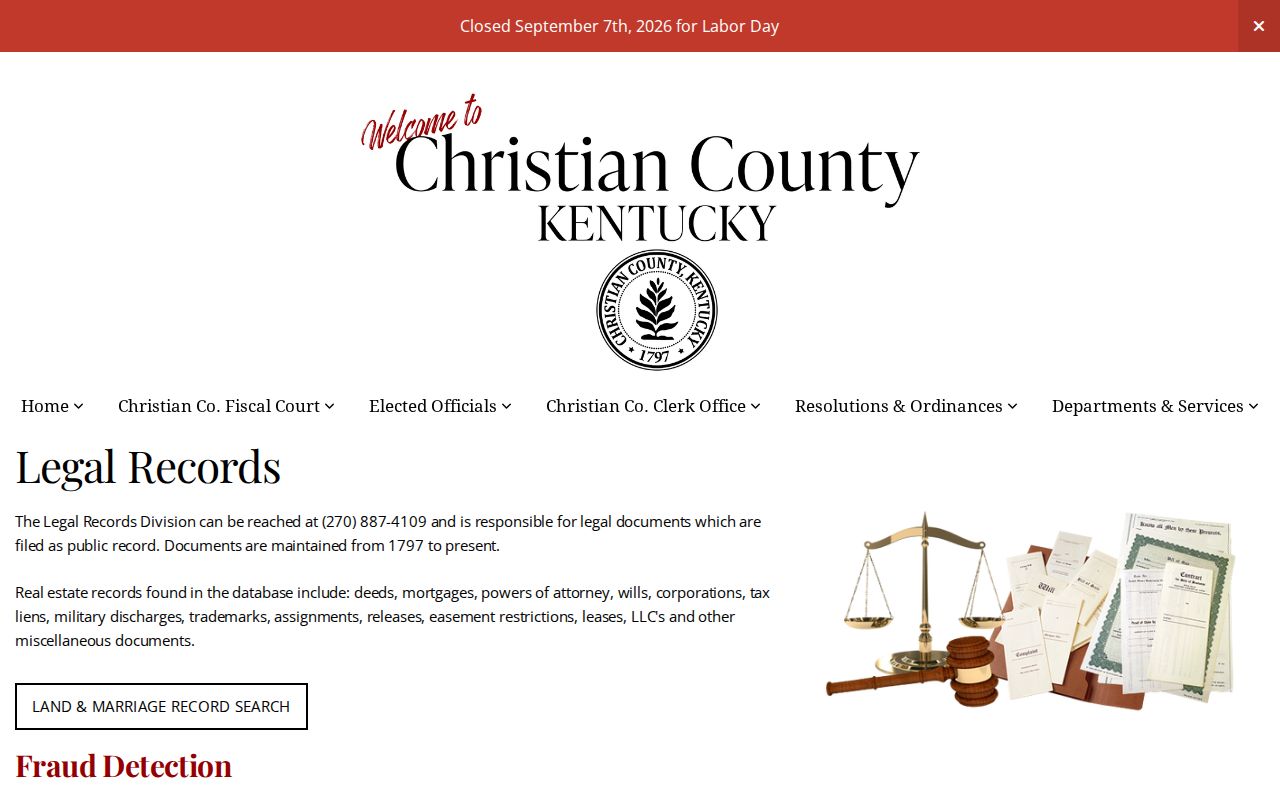
The custodian page itself displays the links and categories rather than sample deed results, since the portal sits behind an account barrier.
Request a Christian County Deed Copy
Start with the basics. Give the Clerk the document type, the parties, and an approximate date. A book and page or instrument number speeds the request along. The July 15, 2026 fee schedule sets deed recording at $50, correction deeds at $46, and plats at $50. Certified copies cost $5 plus $0.50 per page after three pages. Ask for the total before you pay.
Older deeds take a different route. KDLA identifies Christian deed microfilm covering 1797 through 1989. The 1864 courthouse disaster destroyed part of the record. Surviving books, tax lists, wills, and local library material help fill the gaps when an index falls silent.
Specify exactly what you need when ordering. Every exhibit and acknowledgment page counts. A legal description can spill onto an attachment. A recorded plat reference may matter more than the first page's summary. Ask the Clerk how the copy will be delivered and whether certification covers the whole instrument. For a chain packet, request each document by its own locator. The land-record office files material by recorded instrument, not by property.
Compare the returned copy against the index entry. Check spelling, party capacities, recording date, and consideration. The parcel description and prior references deserve the same care. An executor, trustee, company, or attorney-in-fact may have signed instead of an owner. Follow the authority document named in the deed. That record could be indexed as a will, power of attorney, court order, corporate filing, or related miscellaneous instrument.
Recorded, not guaranteed. An index shows what was filed, but it is not a title opinion and does not resolve every competing or unrecorded interest.
Trace a Christian County Estate Conveyance
Not every transfer starts with a sale deed. The trail may start with a will. Probate petitions, executor appointments, inventories, court orders, and affidavits of descent can follow before a fiduciary deed carries the land to the heirs. CourtNet can supply the case number. The Christian Circuit Court Clerk holds the actual probate file. The County Clerk's Legal Records Division keeps any recorded will, affidavit, or deed that ties the case to the land.
Begin with the decedent's full name and death date. Search the court record first. Then search the land index under the decedent, fiduciary, heirs, and later grantee. Match the legal description at every step. A will names beneficiaries, so compare the probate order with the recorded conveyance before assuming the parcel passed as expected. KDLA lists Christian County wills on microfilm from 1797 through 2002. That archival path works when the modern index falls short.
Carry the Deed Chain to Kentucky Land Records
A chain stops at Christian County's creation in 1797. The next useful source may be Logan County. Or it may be the Kentucky Secretary of State Land Office. The Land Office searches historical warrants, surveys, and patents by party name and role. County, watercourse, and location searches work too. Start from the oldest verified Christian deed. Preserve the watercourse, survey, adjoining owners, acreage, and patent references. Do that before moving to the state system.
Early tax books show when an owner first appears or leaves a district. Christian County tax microfilm has substantial gaps. Treat a tax entry as corroboration for a deed, will, court order, survey, or patent. Keep a transfer table with date, grantor, grantee, deed type, book and page. Add description changes to it as well. That table exposes missing links. It also keeps a similar name out of the wrong chain.