
Start a Christian County Records Search
Where you start depends on the clue in hand. The Christian County PVA Property Search supports lookups by owner name, address or location. It also supports lookups by parcel number. The basic search is free. Expanded transfer, photo, characteristic, and tax data may require a subscription. A parcel result gives you a stable identifier, which solves spelling and street-name problems fast.
From there, compare the parcel with the County Clerk's recorded deed. Compare it with the Sheriff's tax record too. If an address is disputed, Community Development Services can supply map or E911 material. Each source answers a different part of the question. A PVA entry is an assessment record. A deed is a recorded transfer, and a map is a reference. None of them alone is a title opinion or a boundary survey.
- Try the PVA search with the street address, then repeat with the owner name.
- Save the parcel number, situs address, owner field, and legal-description clues.
- Use the County Clerk land-record search to locate the latest deed or instrument.
- Check the Sheriff portal for the bill and CDS maps for geographic context.
- Call, visit, or file a written request when the portal withholds the needed image.
Offices Behind Christian County Property Records
Christian County property records do not sit at one counter. The Christian County Clerk Legal Records Division keeps recorded land instruments. The PVA maintains parcel and assessment data, while the Sheriff collects property taxes. CDS handles GIS and E911 address work. Court files belong to the Circuit Court Clerk at the Justice Center. Knowing that split saves time. It keeps a deed request from going to the court clerk. It also keeps a tax-payment question from going to the PVA.
Keep a small source log as you go. Note the office, access date, record type, and reference number for each result. That habit shows which custodian supplied each fact. It makes later updates far easier to trace. Keep a copy of every record you cite.
Christian County Clerk Legal Records
511 South Main Street
Hopkinsville, KY 42240
(270) 887-4109
Christian County Sheriff Tax Office
701 West 7th Street
Hopkinsville, KY 42240
(270) 887-4143
Christian County PVA Search Fields
The PVA search is the practical bridge from address to parcel. Its public description advertises owner, location, and parcel-number search modes. A result may include parcel and alternate IDs, the address, and ownership. It may also list the city, area, state, assessed value, and a reference number. The qPublic card itself sits behind an access barrier. So treat that field list as the office's published description rather than a live tour of the portal. Field names and update timing can change.
| Search clue | Useful result | Next check |
|---|---|---|
| Street address | Parcel and situs match | Compare mailing and E911 forms |
| Owner name | Assessment owner entry | Confirm with the latest deed |
| Parcel number | Stable tax identifier | Carry it to tax and map requests |
The PVA's owner field follows the tax cycle. A recent transfer may not yet appear under the buyer's name. That lag is why the recorded deed remains the stronger check on a transfer.
January 1 Shapes Christian County Records
Kentucky assessment work keys everything to January 1. Christian County warns that a purchase after January 1 can leave the property tax bill in the former owner's name. That status holds until the next calendar year. The PVA may send a courtesy copy to the buyer. That does not change the bill's assessment-date identity.
This local rule explains a common mismatch. A new deed can name the buyer while the current bill still names the seller. Record both dates. Compare the deed recording date with the tax year, and ask the PVA about the assessment entry. The difference may be ordinary timing rather than a title problem.
Christian County Property Record Types
A property file can span land, tax, court, planning, and historical collections. Deeds and easements document recorded rights. Assessment data ties a parcel to a tax owner and a value. Tax bills track collection. Plats and GIS products locate tracts. Court dockets can point to foreclosure, probate, quiet-title, or lien litigation. The clerk's case file remains the official source behind any online summary.
| Record Type | What It Documents | Kept By | Access |
|---|---|---|---|
| Deeds and easements | Transfers and recorded rights | County Clerk | Portal, counter, phone, or request |
| Mortgages and liens | Recorded claims and releases | County Clerk | Land-record index and copies |
| Assessment and tax | Owner field, value, exemptions, bill | PVA and Sheriff | Official web portals or offices |
| Plats and parcels | Lot, block, tract, and map context | Clerk and CDS | Recorded plat or map request |
| Planning records | Zoning, subdivision, and site review | CDS or city office | Published forms and open records |
When proof matters, use the instrument itself rather than a broad search result. The Christian County Clerk states that its maintained legal-record series spans 1797 to the present. The public page does not publish an exact online index or image cutoff. The linked system requires an account or access plan. Older or unavailable material therefore needs an office or archival route.
Christian County Deeds Since 1797
The Legal Records Division keeps a deep catalog. It lists deeds, mortgages, powers of attorney, wills, corporations, and tax liens. Assignments, releases, easements, restrictions, and leases are in it too. LLC filings, military discharges, trademarks, and other instruments round out the list. That catalog helps when a simple deed search does not explain a property event.
The linked Courthouse Computer Systems service is not open to unattended inspection. Treat an online index hit as a lead. Wait for the Clerk to supply the instrument image or a certified copy. Search by both grantor, the person giving an interest, and grantee, the person receiving it. Carry the book, page, instrument number, date, and legal description into your request too.
The official page displays the custodian's categories and its search link.
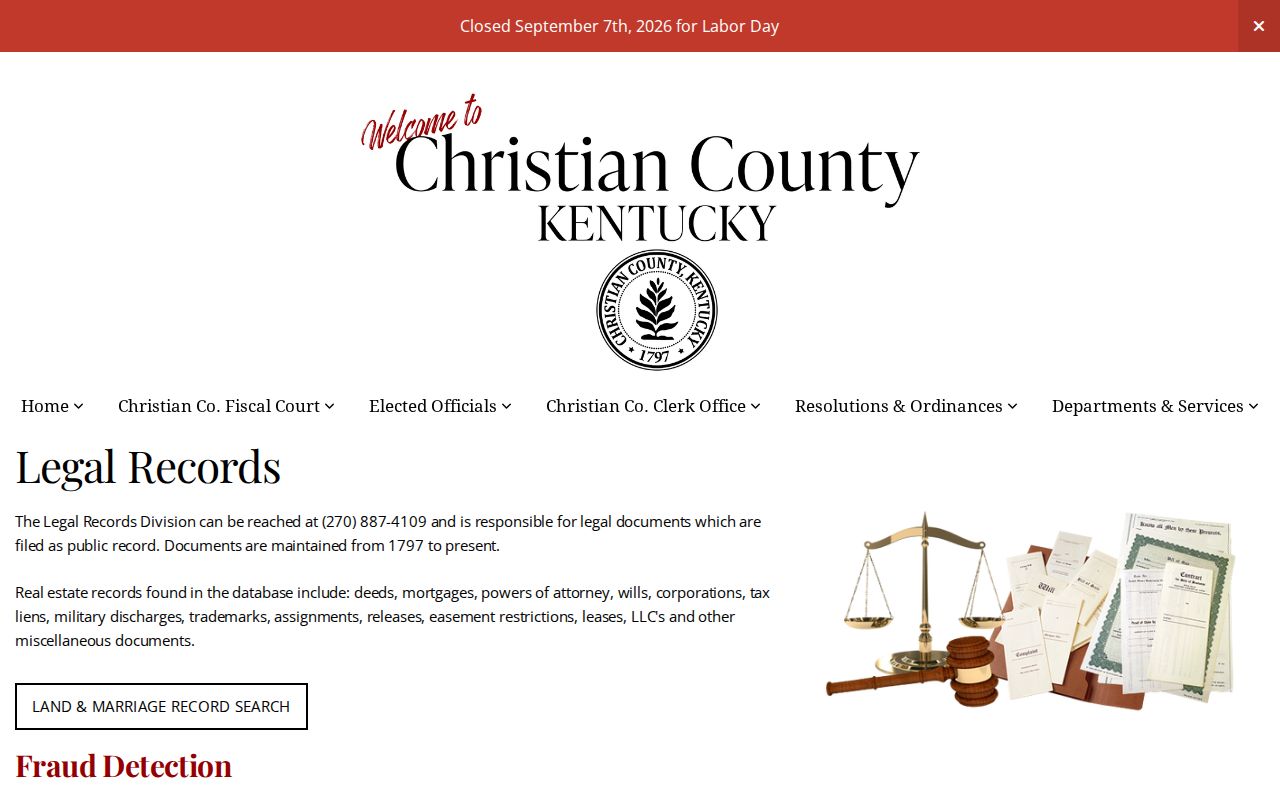
Its 1797-present statement describes the maintained collection, not a promise that every year and image is online.
Christian County Maps Need a Request
Community Development Services publishes county, magisterial-district, Fort Campbell, Hopkinsville city, zoning, ward, and annexation-history maps. The county offers no public interactive parcel viewer. So skip the idea of a click-to-owner map. Ask CDS for map or GIS material covering a defined area, then verify the parcel number through the PVA and the legal description through the recorded deed or plat.
Parcel: a mapped tax unit. Plat: a recorded drawing of lots or tracts. Legal description: the text identifying land in a deed. None replaces a new survey.
Addressing has its own custodian here. The E911 Coordinator assigns new street addresses, gathers GPS points, untangles USPS and phone-company conflicts, and reviews road names. That address history can bridge a modern street address with an older rural-route line or deed description.
Plats Bridge Christian County Records
A plat is where the parcel map meets title. Ask the County Clerk for one. Give a subdivision name, lot and block, surveyor, road, or instrument reference. Planning paperwork may live elsewhere, with CDS, Hopkinsville, Oak Grove, or another city office. CDS rules govern minor subdivisions, replats, consolidations, boundary surveys, major plats, and floodplain development.
Keep the recorded copy and the planning copy separate. Planning approval alone transfers no title. A tax map can hint at where land lies. But the recorded instrument and a licensed survey carry different legal weight. When city lines, ZIP labels, and postal names clash, match the parcel identifier and legal description before concluding anything.
Tax Bills Use a Separate Office
Real-property tax in Christian County is collected by the Sheriff, not the PVA. Its tax information page routes users to the Properly Taxes portal. It also lays out the collection path. The PVA sets fair cash value and handles assessment. Taxing bodies set rates. The Sheriff takes payment. Each act belongs to a different office.
A careful tax search notes the year, name shown, parcel number, district, amount, and payment status. Delinquent matters can pull the County Clerk in later. Christian County's July 28, 2026 sale notice and July 20 registration deadline are time-sensitive leads. Confirm current status with the offices rather than reading it from that notice.
Christian County Court Record Split
Deeds are not kept at the Justice Center. The Christian County Justice Center at 100 Justice Way houses court administration. That includes Circuit, Family, District, and Business Court. CourtNet or KYeCourts offers a statewide case-information snapshot. But the Christian Circuit Court Clerk holds the underlying local file and can point a requester to archived files and locator numbers.
The split matters when land is touched by a mortgage release, judgment lien, probate transfer, foreclosure, or quiet-title action. Search the court system by party or case lead first. Then request the docket entry or document from the clerk. Last, see whether the outcome produced a separately recorded land instrument. That could be a deed, release, lis pendens, or other filing at the County Clerk.
The 1864 Christian County Gap
A courthouse disaster in 1864 is a real caution for historical work. Missing online images never prove an event failed to occur. The Kentucky Department for Libraries and Archives confirms surviving Christian County deed microfilm from 1797 through 1989, surveys from 1797 through 1956, wills from 1797 through 2002, entries from 1798 through 1939, land grants from 1802 through 1805, and an 1878 map on microfiche. The collections include deed microfilm from 1797 through 1989. Surveys run from 1797 through 1956, and wills from 1797 through 2002. Entries span 1798 through 1939, land grants cover 1802 through 1805, and an 1878 map sits on microfiche.
Run two timelines for an old parcel. One follows patents, surveys, deeds, taxes, mortgages, easements, and plats. The other follows owners, estates, businesses, annexation, road names, and zoning. Reconcile the two whenever the legal description shifts. County Clerk books, KDLA material, FamilySearch catalogs, tax books, and court orders can each restore a missing link. Newspapers can do the same.
Christian County Library Record Clues
The Hopkinsville-Christian County Public Library is a clue-finding stop, not a certifying office. Its McCarroll collection holds about 5,000 books. It also keeps local obituary, census, cemetery, will, deed, funeral, court-order, tax-list, newspaper, and yearbook material. The genealogy room sits at 1101 Bethel Street. The published contact is (270) 887-4262 and genealogy@hccpl.org.
Search the library's Community History archive by name and date. You can also use Ancestry on library computers. These tools help identify a former name, a death, a street, or a family link. Then take the finding back to the Clerk, court, or vital-record custodian. Ask there for the government record behind it.
Christian County Deed Fraud Alerts
The county-linked fraud-detection service accepts one email and one to five watch names. Last names match exactly; first names follow a begins-with rule. A confirmation email activates the watch. So spelling matters greatly. This is especially true for an owner with initials, a compound surname, or an entity name.
Treat the Christian County fraud alert as notice, not proof. The service disclaims authenticity and completeness. Match any alert to the instrument number and recording date, then contact the County Clerk. Keep the notice if fraud is suspected.
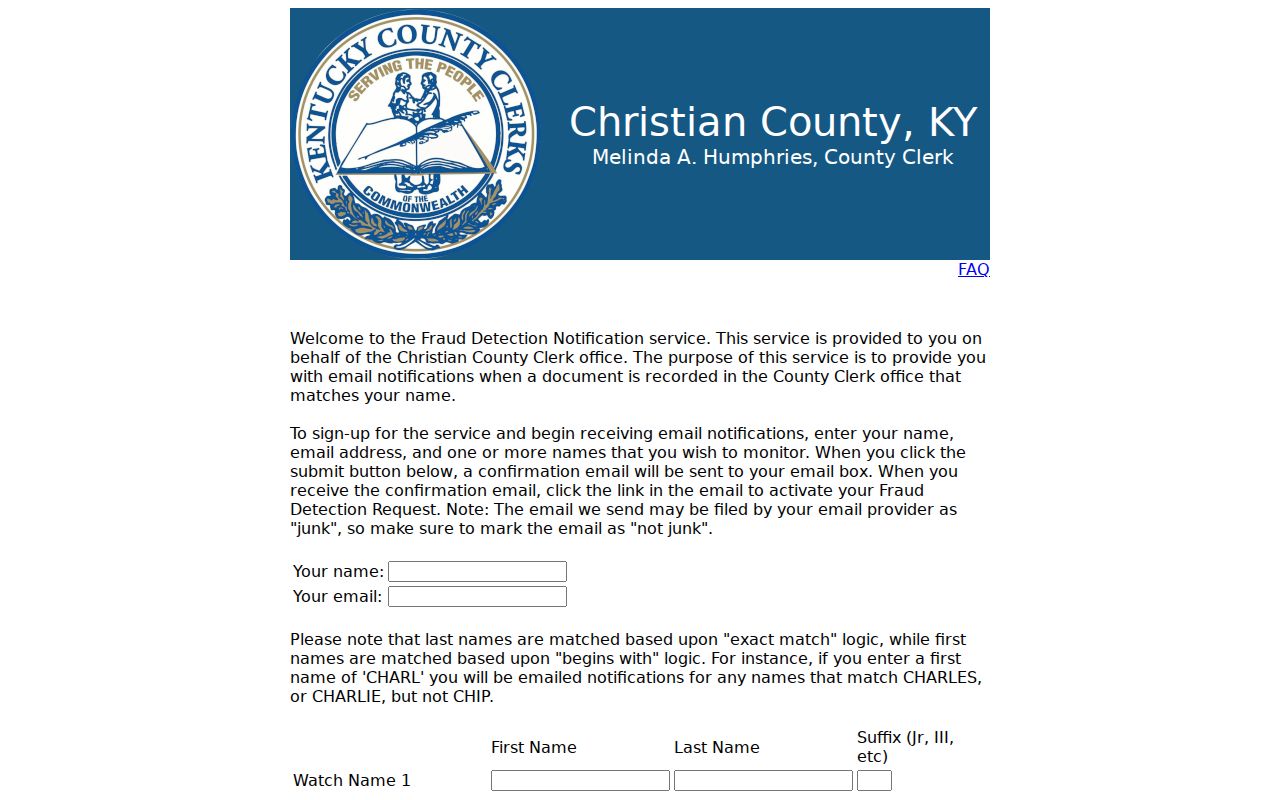
The county's sign-up page displays the name-watch workflow step by step. It supports, but cannot replace, a full deed review.
Addresses Are Not Boundaries
Christian County spans incorporated cities, rural roads, growth near Fort Campbell, and shared planning areas. A ZIP code only sorts mail. It does not mark a city limit or a tax-district line. So a Hopkinsville mailing label never proves where a parcel sits. Keep every address form you meet: situs, mailing, an old rural route, an E911 assignment, a unit or lot, and the legal description on the deed.
Watch directionals and road-name variants. A deed may point to a watercourse, an adjoining owner, lot and block, a survey, a patent, or an earlier instrument rather than a street number. Check the postal form with USPS. Trace address history with CDS. Confirm parcel identity with the PVA, and settle jurisdiction through the city or planning office.
Place names help most as discovery terms. Hopkinsville, Oak Grove, Pembroke, Crofton, LaFayette, Fort Campbell, Pembroke Road, Pembroke Oak Grove Road, South Main Street, and West Seventh Street can narrow a property search. But none replaces a parcel key. When a tract gained an urban address, note the old rural route and the new E911 form together. Ask CDS for the assignment history if the two disagree. Then compare the Clerk's legal description, the PVA situs, and any subdivision plat. That habit keeps a postal change from masquerading as a transfer, annexation, or boundary move.
Limits of Christian County Property Records
Christian County property records carry real weight. They can surface an assessment owner or a recorded grantee. They can surface a parcel number, a value, or a tax bill. They can surface a lien, an easement, a plat, or a case lead. They cannot prove that no unindexed claim exists. They cannot set a line on the ground or forecast a sale price. Kentucky's Safe at Home program masks addresses in many settings. Real-estate holdings are expressly exempt from its ordinary masking rule. A genuine safety concern still belongs with the custodian and program staff.
Use records with care. Public access supports purchases, boundary research, estates, tax review, and civic oversight. It does not permit stalking or harm, and no lookup replaces a title company, lawyer, or licensed surveyor.