
Reading a Christian County Current Owner Record
The Christian County PVA Property Search is the first official stop. It serves anyone tracking the current tax owner. Advertised search modes cover owner name, address or location, and parcel number. Save the whole parcel context. Don't stop at the name alone. The owner field names the roll's owner of record, the situs locates the land. The mailing field shows where tax notices go. Basic ownership and assessed-value access is free through the portal. Expanded transfer, photo, characteristic, and tax data sits behind a subscription.
| Owner of record | Name carried on the PVA tax roll; compare it with the latest deed. |
|---|---|
| Parcel or PVA number | The stable current-system key used to keep similarly named parcels apart. |
| Mailing address | Destination for assessment and tax correspondence, not proof of occupancy. |
| Situs address | Location assigned to the property itself. |
| Assessment fields | Value, class, acreage, exemptions, and characteristics when available. |
| Latest deed reference | Book, page, instrument, parties, date, and legal description found at the Clerk. |
Keep the result in perspective. A Christian County current owner record does not identify every occupant, manager, beneficiary, or person with a financial interest in the parcel. For the deed-search route, the official Legal Records page lays out the path to recorded title.
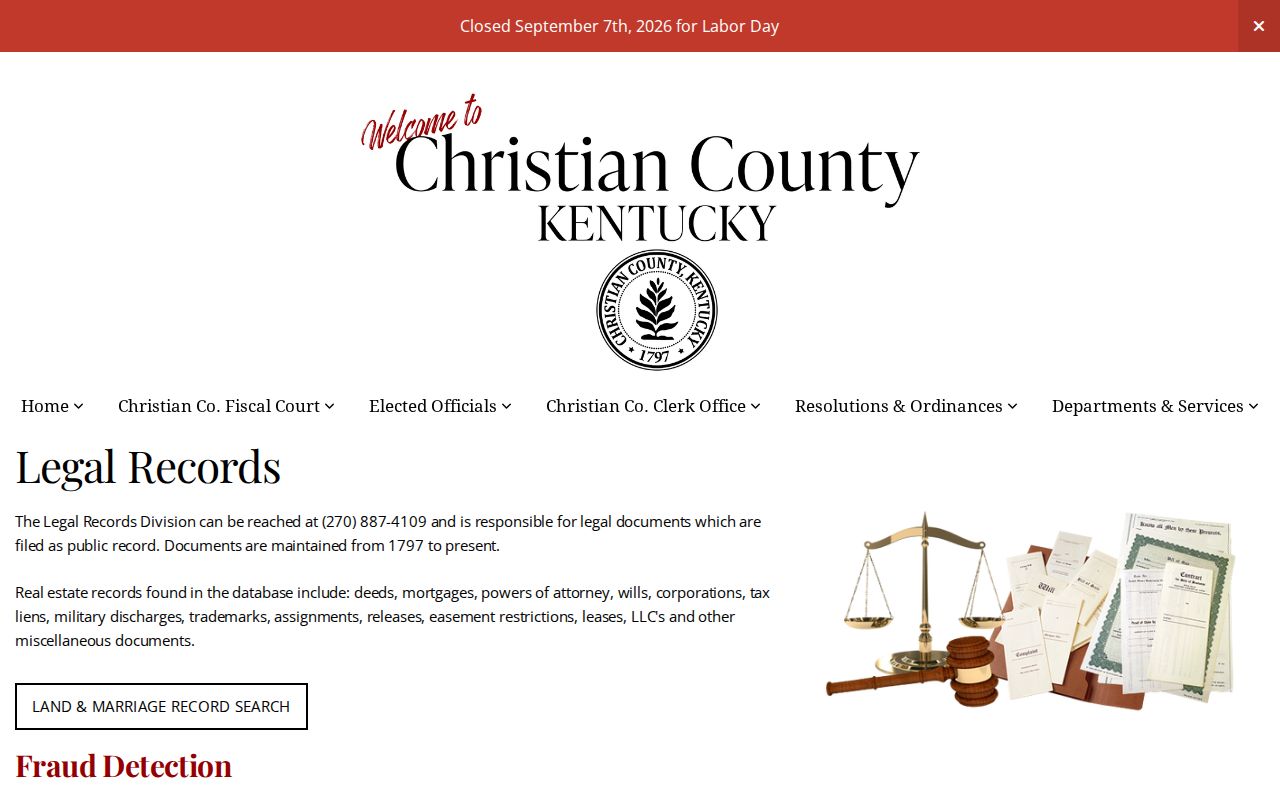
The custodian page names the records office, but the current grantee still must be confirmed in the deed itself.
Why Christian County's January 1 Owner Date Matters
Christian County's assessment date is January 1. The PVA values every parcel as it stands on that day. This creates a quirk worth knowing. Buy a property in March. The deed names you as the new owner of record. The tax roll, though, may still carry the seller's name until the next calendar year. The PVA sometimes mails the buyer a courtesy copy of the tax bill. That courtesy does not shift the official bill name or affect title. Anyone running a current owner search in Christian County should read two dates together. Check the deed recording date against the tax roll year.
Timing key. A seller named on the current tax bill may reflect the January 1 roll, while a later recorded deed may show the current title holder.
The Sheriff collects the taxes. The PVA maintains the assessment. Neither office replaces the County Clerk for recorded title. That division matters most after a recent closing, when three official records can each be accurate for three different dates and purposes.
Separating Christian County Mailing and Situs Fields
Every parcel carries two addresses. The situs address marks the land itself. The mailing address shows where the county sends notices. The two often diverge. Owners who live out of state, trusts, estates, and entities commonly split them. A newer E911 address can also separate the fields. Record both values along with the city or ZIP displayed. Remember that a ZIP is a postal delivery zone, not proof of a municipal boundary, tax district, or planning jurisdiction.
A mismatch between the street address and the deed is not rare. Community Development Services can explain the E911 side of the question. Its coordinator assigns new addresses. The office gathers GPS locations, settles conflicts with USPS and the telephone company, and vets proposed road names. When rural routes, road names, annexation, or postal labels shift over the years, the recorded legal description remains the reliable bridge.
Checking How Current the Christian County Owner Field Is
The PVA follows the annual January 1 assessment rule. Beyond that, it publishes no exact refresh interval. That means no stated lag between a newly recorded deed and the updated qPublic card. Sorting, card labels, and permanent links can also change without notice. So treat the displayed owner as a dated official lead rather than a live fact. Save the parcel number and the date you viewed it. When a very recent transfer or correction makes timing decisive, call the PVA directly.
For a firmer present-tense answer, compare the owner name, legal description, parcel reference, and last transfer against the County Clerk's newest deed. A spelling difference is usually harmless. A different parcel or legal description is not. That distinction matters far more than how fresh a screen appears.
Verifying the Christian County Current Owner
A careful confirmation starts with the PVA parcel. It ends at the Christian County Clerk Legal Records Division. The Clerk maintains deeds and other legal instruments dating back to 1797. The public page, however, does not state the exact online index or image cutoff. The online land search requires an account or access plan. So phone, counter, and written open-records requests remain part of the access chain.
- Search qPublic by the exact situs address and save the owner, parcel number, mailing address, and date viewed.
- Search the Clerk's land index under that owner as grantee and identify the newest deed affecting the same legal description.
- Read the grantee name and title-holding language, then compare the execution, recording, and indexing dates.
- Check later correction deeds, probate affidavits, court orders, or other instruments that could change the result.
- Owner of record
- The person or entity carried by the official record for its stated date and purpose.
- Vesting
- The deed language naming the grantee and describing how title is held.
- Tenancy
- The legal form in which two or more grantees hold an interest, when the deed states one.
- Registered agent
- The public business contact listed for an entity, not necessarily the property's beneficial owner or occupant.
Resolving an LLC as Christian County Current Owner
An LLC or corporation in the grantee field adds one extra step. Search the exact legal name in the Kentucky Secretary of State Business Entity Search. The state tool offers a search selector and a text query. It also has an active-only filter and Advanced Search. Its record can help separate similar entities and identify a registered agent. It cannot rewrite the deed or prove who benefits from the parcel.
Next, search the Clerk under the full entity name and reasonable punctuation variants. County legal records also hold corporation and LLC filings. They include assignments, releases, leases, and other instruments. These may explain the ownership context. A registered agent serves as a service contact only. Never treat that role as proof the agent owns, occupies, or controls the land.
Handling Trusts and Estates in Christian County Ownership
A trust or estate name changes the search. You need the instrument that grants someone authority over the land. For an estate, that could be a will. It could also be a probate order, an executor or administrator deed, an affidavit of descent or inheritance, a survivorship instrument, or a judgment tying the decedent to the current owner of record. CourtNet offers a case snapshot. The underlying probate file sits with the Christian Circuit Court Clerk. The District Court division in Christian County holds it as well.
A will alone rarely proves title moved. Lay the probate order beside any later recorded conveyance and compare legal descriptions. The same care applies to trusts. Match the trustee named on a parcel card to the recorded deed itself. Christian County property records answer who holds title. Beneficiaries whose names never entered the public land record are a different question.
Correcting a Christian County Owner or Address
Pick the correction path that fits the error. A wrong owner or mailing field belongs with the PVA. Support it with whatever evidence the office asks for. Deeds, wills, death certificates, and court instruments can all support a fix. The right one depends on the cause. A title problem is different. No informal parcel-card edit cures it. The corrected deed, probate, or court instrument must reach the proper custodian for Christian County property records.
Build a small packet before you call. Include the PVA number, both addresses, and the displayed name. Add the latest deed reference and the date of each source. That packet shows quickly what you face. It may be a spelling error, a tax-roll lag, an E911 address change, or a genuine title defect. The Christian County owner-finding route shows how these pieces connect.
Using Christian County Current Owner Data Lawfully
A tax-roll mailing address is public, and property-related correspondence through it is legitimate. It is not proof anyone lives there. Kentucky Safe at Home substitutes addresses and adds protections for eligible participants, yet official guidance expressly leaves real-estate holdings outside ordinary masking. None of that licenses a hunt for nonpublic data. Restraint still governs every Christian County property search.
Lawful use. Use a Christian County current owner record for legitimate property research and correspondence. Never use owner data to stalk, harass, intimidate, or harm anyone.
A parcel card is not a certified title opinion. An owner of record is not necessarily an occupant. Before any transaction or dispute in Christian County, pull the recorded instrument and get professional review rather than trusting a name copied from a public screen.